
Tips for Applying to UT-Austin Computer Science, Cockrell School of Engineering, and the College of Natural Sciences

Motorcycle trip in northern Thailand
Introduction
I address why STEM programs are so competitive, especially relative to non-STEM programs. Second, I highlight trends before providing advice for UT Computer Science, The Cockrell School of Engineering, and the College of Natural Sciences.
If you skip straight to the bottom without reading the first half, you will have a very incomplete understanding of the STEM admissions landscape. Knowing “how to” apply without understanding “why” won’t adequately inform you.
Nevertheless, I published more recent posts about UT STEM Honors programs, alternatives to CS, applying for Business/CBHP, for external transfer into STEM/Business majors, and the difficulties of changing majors into STEM/Business for current UT students.
This post focuses exclusively on regular admission and not honors. Everything that applies to being competitive is the same for honors, only that the degree of Honors competition and selection is even more extreme. There are no secret honors admissions insights other than to have low expectations for getting in.
— Kevin Martin | kevin@texadmissions.com
An Overview of STEM College Admissions Nationwide
College admissions across the nation have become substantially more competitive nationwide since COVID, particularly for STEM majors. UT is no exception.
To get one FAQ out of the way first: top 5% admissions DOES NOT guarantee UT STEM majors. These spaces are competitive for everyone, and there doesn’t need to be a 75/25 ratio of top 5% like for the university overall. The top 5% only guarantees Liberal Arts, Communications, Education, and Social Work. Years ago, Natural Sciences was guaranteed and, to a certain extent, McCombs, but that hasn’t been the case for a long time.
A consequence of our society’s fascination and push toward STEM degrees means there is WAY more consumer demand than classroom spaces that universities can supply, particularly for top 50 programs. UT received around 3,000 computer science applications in 2016, and they likely receive 10,000+ nowadays for an admissions rate of around 5-10%. That means many highly qualified applicants will be left out. Even Texas A&M and UT-Dallas reject many STEM students they would have admitted in admissions cycles before COVID. Texas A&M also seems to be rejecting top 10% applicants in engineering for the first time ever.
Since Fall 2022, I have had clients scoring 1550/35+ ranking in the top 5% rejected to varied UT STEM majors, including biomedical engineering, computer science, and even less-known majors like neuroscience and environmental science. I’ve even had students in the top 10% scoring 1500+ rejected from majors with many spaces, like biology and math, who would have almost certainly gotten in before COVID.
It isn’t enough to be a top 2% student with a 1580 who is a varsity athlete or band member, and not much else, if you want computer science or a selective engineering major. You must have a deep and varied commitment to STEM activities, ideally from freshman year or earlier. I had a student ranked 5 out of 1000 and a 36 ACT rejected to UT Biomedical Engineering (yet admitted to Rice Early Decision after a deferral). I had multiple clients rank in the top 2% and 1550+ rejected to CS, some with decent STEM-related extracurriculars and skills.
These academically perfect students would be a shoo-in for regular admission in prior cycles, and our work focused on UT Honors and the top 20 nationwide universities. I used to be able to assess a STEM applicant based on their academics alone, but nowadays I need to see their resume to gauge whether they have a chance.
The primary takeaway for applicants: if you want a STEM major, it is absolutely essential to have relevant extracurricular experiences.
Families nowadays mostly accept that if your student has a 3.8 and a 31, you’re not getting into Stanford. They fail to realize that Carnegie Mellon University (CMU) Computer Science admits an average SAT Math score of 800, meaning that every competitive applicant must have a stellar resume in an already competitive applicant pool.
For anyone less than exceptional, you’re better off saving your money on app fees and buying literal lottery tickets, where your odds of a return on investment may be more favorable than the astronomically low chances of getting into top STEM programs with anything less than an exceptional application.
Great essays are essential for getting in, but they’re no guarantees. They might not compensate for anything less than stellar academics and a resume. Poor essays will sink even the most accomplished applicants. That’s one reason I have relatively high academic minimums for taking on clients. One of the most frustrating aspects of American college admissions is that students don’t know what it takes to get in. In practice, a Holistic Review means you must be outstanding in everything.
An OOS-admitted UT-Austin Turing Honors client with a perfect GPA and ACT scores and a strong STEM resume gained admission to three other top-20 CS universities, along with a few excellent scholarships. CMU, Illinois, various Ivy League schools, and the UCs, including San Diego, also rejected them. Another Turing-admitted student had similar outcomes despite various nationwide STEM high-level achievements and flawless academics. I’m certain both applicants would have been admitted to the top 10 CS programs before the pandemic. Because competition is so intense, even the best applicants rarely gain admission to the programs they apply to.
You’re lucky to get into a single-reach school, even when you apply to ten or more. Applicants have incentives to apply to twelve or more CS programs because there are few assurances of having success, which feeds into the increased competition. For example, UT-Austin occasionally denies applicants admitted to the Ivy League or its equivalent. Gaining admission to one high-reach doesn’t imply favorable chances at another – outcomes are inconsistent, variable, and, in practice, mostly inexplicably random at top 50 universities.
My recommendation moving forward is not to apply to Stanford, Harvard, Princeton, MIT, Caltech, Carnegie Mellon, or similarly ranked CS programs unless you can afford the full cost of attendance. To be competitive, you must have otherworldly credentials, as if you’re the greatest applicant your community has produced in living memory or a national and international champion in something STEM-related. These are the most time-consuming applications, and you’re wasting your time and money if you’re not a top student on the planet.
What was true of Ivy League and equivalent universities a generation ago - that they were tough but not unattainable - is increasingly the case for STEM programs at flagship public and STEM-oriented universities in states like Texas, California, Michigan, Washington, North Carolina, Georgia, and Virginia. Gaining admission as an out-of-state applicant is especially challenging. UT’s out-of-state admissions rate in Fall 2025 was 5%.
Many of these programs today, particularly for Honors, are more selective than Stanford or Princeton were thirty years ago. When exasperated parents tell me they can’t believe how much college admissions has changed since they applied, they're right.
One irony is that it’s almost certain late-career admissions professionals wouldn’t have gained admission to their alma mater if they were applying today. I’m confident that most extremely high-achieving applicants are more talented than the counselors reviewing their files. College admissions officers are generally well-meaning if painfully unremarkable. As a reference point, I was UT Admissions’ first and only Honors graduate to work in the office.
Given the highly competitive STEM landscape, “chancing” and assessing chances at most selective programs is largely a waste of time and an exercise in futility, as I argue in this Admissions Madness blog post.
No STEM applicant to prestigious programs is safe.
Below, I make my best-educated guess about which colleges/schools/majors are more or less competitive than the other. You’ll note that most STEM majors trend toward being more competitive than non-STEM majors, less so. I estimate the McCombs Business somewhere between Natural Sciences and Cockrell Engineering.
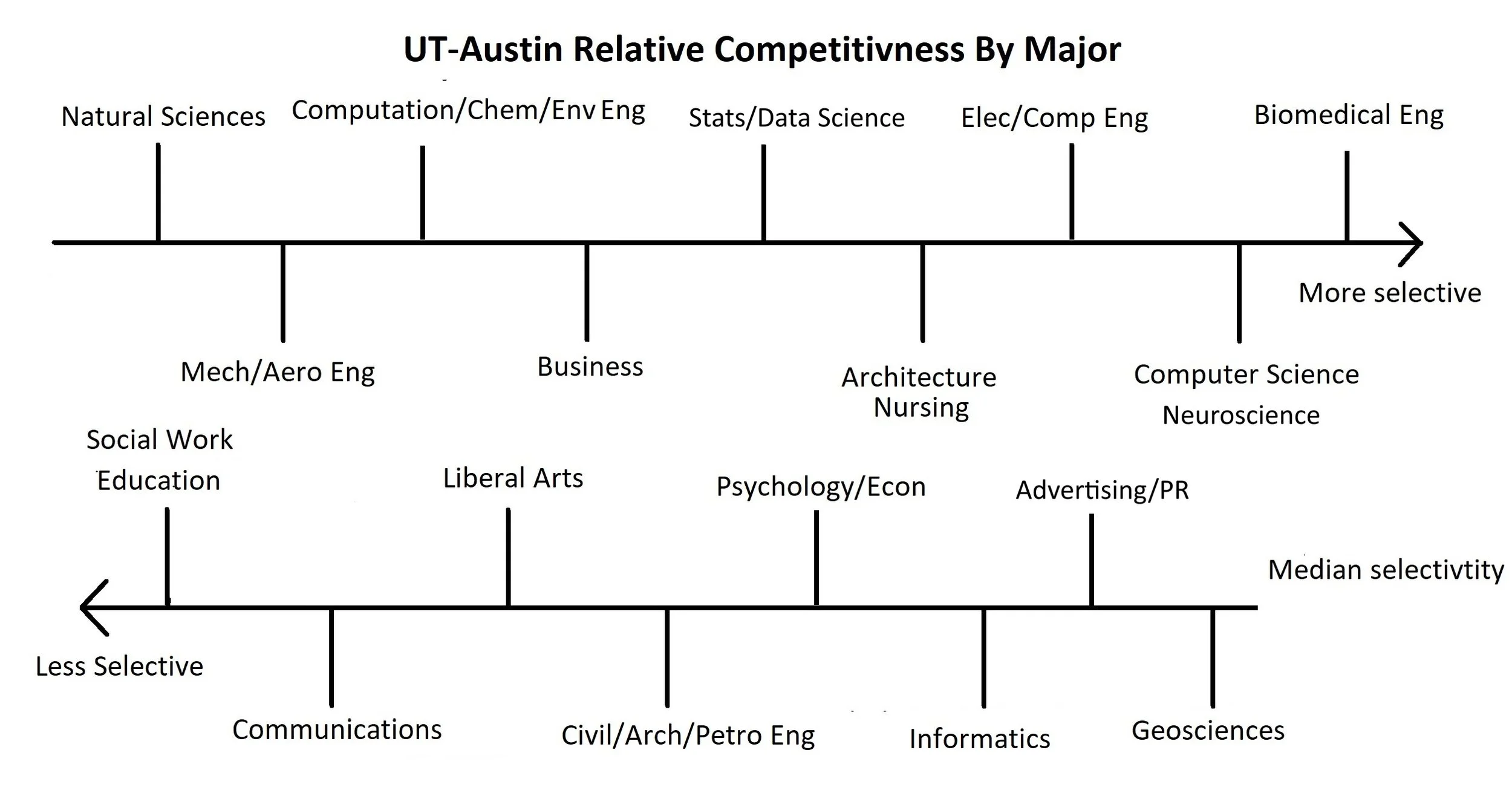
Fine Arts is excluded because their admissions processes vary so widely between majors that it isn’t helpful to plot them.
One reflection of this trend toward engineering and the sciences is a substantial increase in Medical School applicants. Before COVID, the rate of change may fluctuate two or three percentage points, but in the last med school app cycle, the number of applicants increased 18%. Similarly, despite record burnout and early retirements, Nursing school applications have risen by 15% since before COVID.
I lament that Holistic Review and “fit for major” incentivize students to specialize so early on. Students understandably feel pressure to commit themselves to interests and activities that may not appeal to them in order to pass through the admissions gatekeepers. Well-meaning parents and teachers reinforce this urgency, often toward a few narrow career pathways, such as medicine and engineering. It isn’t enough to simply be a decent student and citizen anymore.
The Resume and Transcript arms race is where we are, though, so if you have any inkling toward STEM, you need to begin exploring those interests as early as possible. If you decide during your junior or senior year that you want STEM but don’t have the corresponding math and science profile, I suggest carefully assessing your expectations. You’re not going to get into UT CS even with perfect academics, although you may have a shot at Texas A&M or UTD.
This is not at all the kind of advice I would give pre-COVID - I don't think students and families need to surrender their interests and values entirely to the admissions gods - but the extreme competition for STEM spaces requires playing the game starting in middle school.
I loathe how college admissions incentives corrupt families, communities, schools, and value systems across our state and country, the focus of my recent book, Surviving the College Admissions Madness. There is much I would change if I could wave a Magic College Admissions Wand.
Since COVID, more students are applying to more universities than ever. Common Application submissions increased by 11% during the first COVID year, when in previous years they may have grown by a few percentage points. Googling admissions rate increases for any university in the top 100, and you’ll see increases anywhere from approximately 20% at UCLA to 60% at Harvard or even 100% at otherwise obscure Colgate. UT’s overall application numbers increased from 73,000 for Fall 2024 to 100,000 in Fall 2025 and 2026. Most of those increases came from STEM and business major applicants.
I wrote the first version of this post in March 2022, and the 2023 admissions cycle suggests a substantial increase in STEM/CS applicants. A May 2023 Washington Post article covers the dramatic rise in Computer Science students at the University of Maryland, reflective of broader nationwide trends. Significantly more students are applying for STEM majors than non-STEM programs.
Historically less selective, Auburn admitted 85% of its Early Action applicants. Since COVID, that number has dropped to 25%. It shocked me when a few of my clients were rejected. The Admissions Madness was largely confined to elite top-50 universities, but it seems the insecurities of rejection at highly selective universities trickle down to second- and third-tier schools. Families need to re-evaluate their conceptions of which schools are a match and safe.
UT STEM programs are not a safety school for anyone.
Universities are to blame
One issue among many is a lack of transparency at most universities. We have no idea exactly how competitive a given program is because most Offices of Admissions do not release their data. That means the public cannot assess how competitive biomedical engineering is compared to biology or the relative competition between Electrical/Computer Engineering and CS. That requires observers like me to make their best educated guesses, which I visualized in the introductory line chart.
Another layer of uncertainty, particularly for UT College of Natural Sciences (CNS) applicants, is which majors are “impacted” and which are not. For most colleges and schools, UT makes decisions at the “college level,” meaning it doesn’t matter whether you apply for biology or nutrition in CNS. For most majors, but not all, enrollment managers generally allocate spaces among CNS applicants.
However, there are exceptions. UT computer science is certainly separated, with CS applicants evaluated against one another. It is unclear whether other in-demand majors, like neuroscience and environmental science, are also evaluated at the major level. It could be that all CNS applicants are compared with others in the same first-choice major, as with Engineering majors at the major level, but we have no way to know.
Similarly, in the College of Liberal Arts, I have reason to believe that the most in-demand majors, Psychology and Economics, are evaluated at the major level, so it might matter which major you choose, and it might not. There may be other small programs, such as Urban Studies and Environmental Science, that are also separated, particularly in transfer admissions. Moody Communications might also separate out the most popular majors, Radio-Television-Film and PR/Advertising, but it’s unknowable.
Students with varied interests have a stake in accessing this data because they may want to hedge their bets by applying to a comparatively less risky major if they’re outside of the top 5%, and the main priority is UT enrollment, irrespective of their major.
Moreover, your second choice selection on Apply Texas is highly unlikely to be offered - it’s an anachronism from a decade ago. Nowadays, it primarily allows students to apply to multiple honors programs, resulting in confusion for thousands of families. Lack of transparency around UT’s first- and second-choice major system perplexes thousands of families each cycle.
Since many universities, like UT, pigeonhole students into a first-choice major and make it difficult for them to change their major once they arrive on campus, it isn’t enough for most families to merely gain admission. They also need their desired major.
Check out this post: “Internal transfers seem really unfair for unsure new students.” Many current UT students on Reddit lament the difficulty of changing majors. The takeaway is that if you want a STEM major yet are not offered it as a high school senior, you should strongly reconsider enrolling at UT.
This raises a more significant point about a lack of accountability to the public. I’ve heard directly from admissions counselors that they feel the general public can’t handle the information, unlike the mixed messaging by US entities and institutions throughout the pandemic. When I worked for UT, I was trained to tell families the numbers don’t matter. They even stressed that we must deceive ourselves into believing that all majors are “equally competitive.”
Infantilizing of the public by university bureaucracies and their public relations/communications teams will be a common theme throughout your admissions process. Official social media channels like YouTube, Instagram, Twitter, and Facebook are finely manicured, mostly unhelpful university promotional pieces.
Get used to being in the dark during the most consequential application of your life. University bureaucracies hold all of the power, and you’re at their mercy. They’re not interested in informing, only persuading you to apply and probably get rejected for the privilege of paying six figures for their higher education services, of which they have an accreditation monopoly.
Can you imagine a car dealership that rejects three in every four buyers willing to finance a luxury car?
I’ve worked with and observed over ten UT admissions cycles, and not a single one has proceeded smoothly. They’re all littered with miscues, errors, and unnecessary obfuscations. Admissions gatekeepers are not infallible, omniscient gods.
The information the public most wants isn't accessible, so unaffiliated and unauthorized blogs like mine are so popular. The more than $2 billion college consulting industry responds to the inefficiencies and incentives that universities themselves create. Understand that Offices of Admissions and Enrollment Management are glorified sales teams, not the tax-subsidized institutions that are supposed to be accountable to the public. They artificially keep their program spaces small to maintain or elevate their prestige.
Rolexes are unremarkable if they cost $100, and everyone has one. Likewise, Harvard maintains its hold on our collective consciousness by graduating fewer than 2,000 students each year since the 1920s. UT has expanded its incoming class size by around 1,400 since 2007, from ~7,200 to 8,600. Rice has committed to increasing their enrollment by 20% over the coming years, but it isn’t enough to keep up with the demand for STEM degrees while balancing concerns about diluting educational quality.
However, in many cases, rapidly increasing demand outstrips a university’s theoretical capacity to supply spaces, particularly for computer science and engineering. Universities struggle to hire and retain enough qualified computer science instructors who are offered lucrative compensation packages in the private sector. Decreased state and federal funding and institutional support also stretches thin a university’s resources.
Consider the perspective of a long-time computer science lecturer, Nicholas Weaver at California-Berkeley, who warns that “their CS department is on the verge of collapse.” Berkeley struggles to accommodate their CS students with enough class spaces, let alone the many hundreds who attempt an internal transfer after arriving on campus.
The New York Times published an investigative piece about struggling to find spaces in CS classes required to graduate, featuring UT-Austin CS in particular. Getting in is only the start of many computer science students’ woes. Some intro CS classes, even at prestigious universities like Carnegie Mellon, might top over 500 students. This was happening before COVID and has since amplified due to staff shortages and record numbers of university applications. Imagine paying $70,000 in annual tuition and not getting the classes you need to continue the degree sequence. There are few options to remedy the situation, and none of them are student-friendly.
Nevertheless, as I argue in my 2021 book, Surviving the College Admissions Madness, elite universities do not care about you.
Should you bother applying to a top 20 university? Almost certainly not.
Almost everyone asks me about this nowadays, so I want to provide a reality check. If you have to ask whether you’re competitive for a top 20, you’re not. Genuinely competitive applicants don’t even bother asking the question. The competition landscape for top 20 admissions is beyond what most families can visualize, and no admissions calculator, AI tool, or Reddit thread will give you an honest picture of it.
I expand the scope of the top 20s beyond the most prestigious private schools (Ivies+) to include applying for flagship public institutions as an out-of-state applicant. OOS admissions rates for non-residents applying to UT is 5%. The OOS admissions rates are similar at the most in-demand public schools, such as Michigan, Georgia Tech, UC-Berkeley/Los Angeles, Virginia, and UNC. Elite programs like Michigan Ross, UW-Seattle CS, UIUC CS, and Berkeley EECS are similarly selective as the most competitive private universities, like Stanford or Harvard. These schools and programs appear on almost every prospective student who emails me, yet almost none of them will gain admission to any of them. The apps are also very time-consuming, so it’s an exercise in futility. Even then, if they somehow manage to get into Berkeley or Michigan, I’m not at all confident the $400,000 four-year degree cost is worth it.
I wrote a chapter about this landscape in my 2021 Surviving the College Admissions Madness, and the competition has only steepened since then. Here is the actual math. There are roughly 3.8 million American high school seniors each year. About 300,000 to 350,000 of them will apply to at least one top 20 university, submitting somewhere between 800,000 and one million individual applications across the group. At the end of that process, approximately 35,000 US students will actually enroll at a top 20 school. That means if you are not, roughly speaking, in the top 1% of all American high school seniors by academics and resume, your chances approach zero.
The picture gets steeper for STEM and business applicants. A meaningful share of those 35,000 enrolling students will be in humanities and social sciences, so the pipeline for technical and pre-professional fields is considerably narrower. At many schools, Regular Decision admission rates for STEM and business programs have fallen to somewhere between 1% and 4%, well below the published overall rates you will find on any school's website.
A common response to these numbers is to treat the top 20 admissions as a lottery: the odds are terrible, but someone has to win, so why not enter? This framing is seductive but wrong, and it has a name. Nassim Taleb calls it the ludic fallacy, an error in reasoning that applies probabilistic reasoning as in a casino game but to situations with incomplete and unknowable information. The mistake of using clean, well-defined probability models to reason about complex real-world situations where the underlying variables are not random at all. A lottery is genuinely random with all ticket holders having an equal chance of winning. Top 20 admissions is not.
The students who enroll are not 35,000 lucky ticket holders drawn from a pool of 300,000. They are a highly non-random subset with specific, extreme characteristics that most applicants simply do not share. Treating admission as probabilistic, as in "I have a 10% shot, so I might as well try,” misrepresents the problem entirely. You do not have a 10% shot. You either have a realistic shot, or you do not, and the honest work is figuring out which category you are in rather than taking comfort in aggregate statistics that do not describe your individual candidacy.
What does it actually take to be competitive?
That is genuinely unanswerable, and I say that as a counselor who has worked with dozens of the highest achieving students, almost all of whom routinely get denied to top 20s. The more useful question is: do you have flawless academics and a resume with national or international level accomplishments? If the honest answer is anything short of yes, applying to top 20 schools is unlikely to be a productive use of your time, energy, or emotional bandwidth during one of the more consequential years of your life.
The students I see harmed most by the top 20 applications are not the ones who apply knowing it is a long shot. They are the ones who apply, genuinely convinced they have a chance, receive universal denials in the spring of senior year, and then have to process that outcome while simultaneously navigating enrollment decisions. The psychological toll is real, and so is the practical cost: top 20 applications require serious essays, and the time spent on applications with near-zero probability is time not spent strengthening applications that actually matter.
There is also a demographic component. If you’re not super elite, you’re cooked.
My blog audience and client base are primarily upper-middle-class suburban families in senior-level professional roles, rather than the elite and super-elite top 1% and .1% families. I argued in my 2021 Admissions Madness blog posts that “Your ZIP Code is the Most Important Admissions Factor.” That’s even truer today.
The Harvard economist Raj Chetty, who I’ve cited for the past decade, released a study with co-authors from the Opportunity Insights project in 2023 and updated for 2025 that “Children from families in the top 1% are more than twice as likely to attend an Ivy-Plus college as those from middle-class families with comparable SAT/ACT scores.”
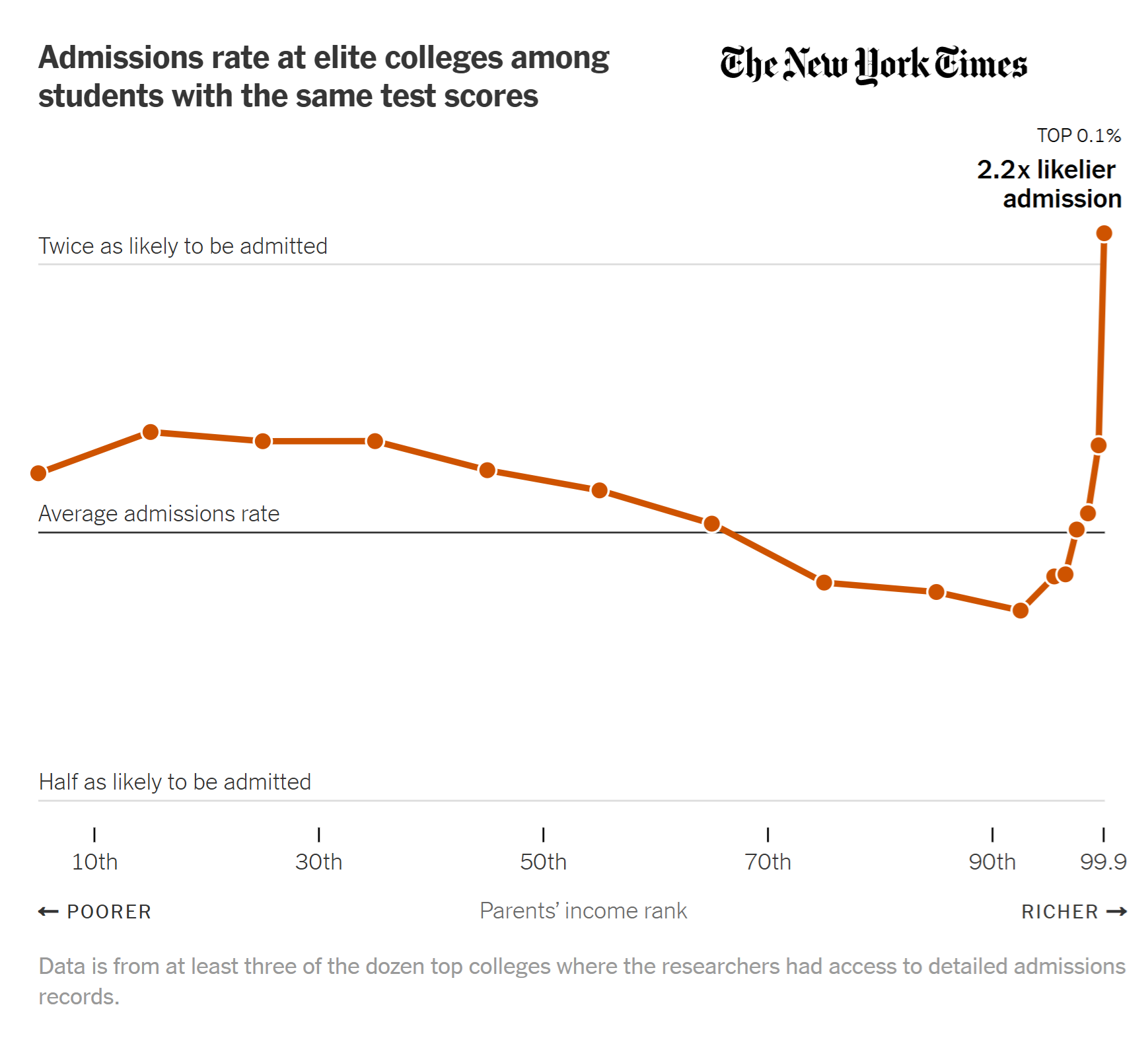
From the NYT: Study of Elite College Admissions Data Suggests Being Very Rich Is Its Own Qualification. July 23, 2022
A partial explanation is students from super-elite communities have privileges and opportunities that far exceed those in the suburbs. Children are groomed from an early age to attend the same or similar elite universities as their parents. Private schools account for around one-third of students at top 20 universities despite public schools overwhelmingly graduating more seniors each year.
These children often attend super-elite private and boarding schools that serve as pipelines to top 20s, a kind of side-door that the ultra wealthy have that the engineers and doctors living in Frisco or Round Rock do not. Certain super-elite schools like Exeter, Boston Latin, and Andover send more than ten seniors to Harvard each year, or Lawrenceville, next to Princeton’s campus, which sends a disproportionate amount of students there each year. Despite working with many students admitted to top 20s over the years, the same dynamic plays out on the west coast. Stanford remains elusive. One reason might be that elite Bay Area schools are extremely over-represented at Stanford. So, the true admissions rate for upper-middle-class communities for STEM majors is much less than 1%.
The Opportunity Insights admissions data only goes through 2015, despite an update in 2025, and given the widening social inequality and K-shaped economy since COVID, we can expect the admissions gap to widen between upper-class and upper-middle-class families. Consequently, non-legacy, non-super-elite-connected, suburban families at strong but not super-elite schools face so many competition hurdles that admissions statistics can never communicate that it’s like running a 100-meter dash starting two seconds later than the other runners.
The Chetty data also shows that attending an Ivy-Plus college increases a student's chances of reaching the top 1% of earners by 50% and nearly triples their chances of landing at a prestigious firm. But those outcomes are measured against attending a state flagship, not against the children of top 1% families who arrived at the same institution with legacy networks, family social capital, and generational wealth already in place.
In other words, getting in is not the same as competing on equal footing once you're there. The child of a Goldman partner or a third-generation Harvard legacy arrives at college with internship pipelines, alumni networks, and family connections that no admissions office can redistribute. A student from The Woodlands or Sugar Land who earned their seat on academic merit alone enters the same building but a different social ecosystem.
The compounding effects are significant. Elite family networks accelerate access to the most competitive internships, which feed into the most selective graduate programs and employers. Social capital inherited across generations is not neutralized by four years of shared coursework.
Moreover, AI displacement is not hitting all careers equally. The professional roles that upper-middle-class families have historically used as reliable pathways to prosperity, law, medicine, finance, and consulting are precisely the white-collar fields most exposed to automation in the next decade. The hedged bet that a top 20 degree represented for previous generations is becoming a less reliable instrument at exactly the moment when getting there has never been harder or more expensive. That corresponds with my argument in this post that debt-minizimg public educations at flagship institutions are a much less riskier.
A final irony to all of this is that many suburban families point to poor and working-class communities as “taking their spaces,” especially with the top 5% law, when the reality is elite college admissions has so many structural advantages for the top 1% that the bottom 95% would be wise to organize against if it were possible.
What to do?
The healthiest framework, in my experience, is to not set the top 20 admissions as a goal at all. Be genuinely open to UT Austin, Texas A&M, and other strong programs where your candidacy is competitive. If a top-20 outcome occurs, it will be a genuine surprise worth celebrating. If it does not, you will have spent your senior year building toward something real.
One legitimate exception: binding Early Decision at a top 20, for students who are genuinely prepared to enroll at that school, pay full price if necessary, and make that commitment before knowing their UT outcome. ED does meaningfully improve odds at most schools. But ED only makes sense if it is a true first choice, not a hedge, and not a gateway to a cascade of Random Decision applications that carry admission rates in the low single digits.
The STEM/Non-STEM Bifurcation
With this rising tide of applicants, admissions rates for STEM programs are decreasing significantly compared to those for non-STEM programs. The STEM/non-STEM bifurcation is a division within universities between their most in-demand majors and less popular ones.
Most universities, including UT, do not provide this data beyond the federally mandated “Common Data Sets,” it is impossible to know the true selectivity for your desired program. As a STEM applicant, you can safely assume your admissions experience is more challenging than that of most non-STEM students.
One complicating factor in discussing Admissions Rates is that most universities have many parallel enrollment management processes running simultaneously. At UT, it is evident that non-STEM majors like Communications, Liberal Arts, Education, and Social Work are substantially less competitive than the university median. When UT admits 17,000 or so students, it must forecast within a small margin of error which admitted students from what majors are likely to enroll.
Applicants who rank in the top quarter, scoring 1300, routinely get into these programs. In contrast, almost nobody with those stats is gaining admission to the natural sciences or most engineering majors, barring extreme luck or special circumstances.
The first question I encourage you to ask when your friend got in with a lower rank and SAT is to ask what major they applied to. More often than not, family gossip compares STEM apples with non-STEM oranges.
When you’re applying to a university, you’re actually submitting an application to one of many of these parallel, shadow admissions systems that need a certain amount of athletes, majors, diversity, band, legacy, professor’s/donor’s kids, etc. Scrutinizing Naviance Scatterplots or other data is mostly a waste of time because they don’t disaggregate the data, often only plotting GPA and test scores without regard to major, resumes, or essays.
Even for a school like Rice or Stanford that considers your proposed major but doesn’t explicitly admit a quota of computer scientists or engineers, it is certain that applying for a STEM major is much more competitive than if you wanted anthropology or communications. Non-STEM applicants find it comparatively easier to apply to the top 50 universities than their STEM counterparts.
This bifurcation looks different at every university, and there may be multiple forks (like within CMU’s Fine Arts programs that admit less than 5% of their applicants) depending on their offerings and program prestige. When universities that don’t lock you into a major say they don’t weigh or consider your proposed major, they’re bullshitting you.
Stanford and Rice will never admit four-fifths of their incoming class as computer scientists and engineers because that would crowd out non-STEM students whom their universities also accommodate, even if the overwhelming majority of their applicants want STEM majors. Gaining admission to English Literature at any university will always be less selective, no matter what their official sources tell you.
For STEM-predominant universities like Caltech and MIT, average SAT/GPA stats are essentially meaningless. Unless you know one of their admitted students personally, you won’t have much of an idea of just how exceptionally, phenomenally, ridiculously accomplished the average MIT admit is. Unless you have national and international level accomplishments alongside perfect academics, don’t even bother applying to STEM programs at the top 10 universities. You would be floored to see the portfolios and credentials of their denied applicants, let alone the admits.
Families with STEM applicants often drastically underestimate the competition landscape. Even for top applicants, it is very hard to get in, especially for CS and CS-adjacent majors like computer engineering at top 20 universities.
When I caution parents that their top 10% student with a 1480 and a thin STEM resume has virtually no chance of gaining admission to UT CS, they’re appalled. They argue with me. I don’t understand that their child is special, they assert. Then, unsurprisingly, I didn’t hear back from them in January when their child was almost certainly denied.
I love when people surprise me with unexpected admitted student reports with below-average portfolios, but they’re one out of a hundred for those I’m pretty sure won’t get in. College admissions is as much about luck as anything you do as an applicant. I’m more cautious and careful than ever not to inflate expectations with my STEM admissions assessments.
What families fail to realize is that there are tens of thousands of highly qualified applicants, most of whom will be denied their top choices. UT often admits students who were denied admission to CMU, MIT, Princeton, Stanford, and so on.
Being the best CS kid in a mediocre school doesn’t mean much when you’re competing against a worldwide talent pool and against top high schools with resources and endowments that rival regional universities. Houston’s prestigious Kinkaid College Preparatory School’s endowment is $68,000 per pupil, more than six times the spending per pupil for nearby urban school districts.
Fifteen years ago, below-average students at these prestigious schools routinely gained admission to their preferred universities when UT admitted two-thirds of its applicants, but not anymore. Rejections from Princeton or the top 20s end up at UT. UT rejections cascade down to Texas A&M; TAMU rejections end up at UTD; denials from UTD enroll at Texas State, and so on down the selectivity ladder.
Now that even students from Kinkaid and Strake Jesuit, or high-resource suburban schools in Katy and the Woodlands, are routinely rejected from UT-Austin, Elite America is waking up to the shifting college admissions landscape. Services and blogs like mine become more in demand as competition increases and bureaucratic transparency decreases.
Institutions that claim to value diversity and accessibility stand in stark contrast to the reality that the top 50 universities are largely the domains of wealthy, highly educated families. Not only are there record-low numbers of African American and first-generation enrollment at top 50 universities since before the 1960s Civil Rights movement, particularly in STEM, but the elite and affluent are also increasingly locked out of admissions spaces. Almost everyone loses, except for ballooning university endowment portfolios.
As NYU Professor Scott Galloway says, many prestigious institutions are hedge funds with universities attached. However, one step in the right direction toward making UT more accessible is their new ATP program for CS, which I discuss further down.
I have a 30,000-foot view of college admissions, while families have, at best, a sample size of a few dozen family friends and classmates in AP and Honors. Although my client data is limited, since most of my clients have top 5% rank and test scores, and I can control the essay variable, it reveals the importance of the resume variable more clearly.
A STEM-oriented resume is a necessary condition for getting into CS and engineering for most applicants nowadays.
It is impossible to know the true admissions rates
Furthermore, even for the rare universities that publish granular admissions data based on early action/decision, legacy, diversity, athlete, donors, etc, even if you know that a university might admit 7% of their CS applicants, you don’t know your chances if you’re an unhooked regular decision applicant.
Put another way. If Rice’s overall admissions rate is 8%, and their early decision admissions rate is around 16%, for unhooked, high-income STEM majors applying regular decision, you should assume your demographic’s admissions rate is substantially lower than the 8% published rate. The odds are probably more like one in 20 or 25. Except for the most exceptional applicants, you’re wasting your time applying for regular decisions at top 20 STEM programs. Buy lottery tickets with your app fees instead.
Furthermore, checking the University of Illinois’s overall admissions rate (45%) masks the fact that its Computer Science admissions rate hovers around 7%. Out-of-state students applying for CS at the University of Washington-Seattle are admitted at a 3% (lower than Stanford’s overall!!) rate despite an overall 48% admissions rate. An out-of-state UT-Austin applicant with college-educated parents has no way of knowing the admissions rate for CS, only that it is more or substantially more competitive than that of a comparable in-state student. Googling Illinois’s, UW’s, or UT-Austin’s admissions rates will unknowingly mislead you.
As an applicant, it is important to research your programs and look for incomplete admissions data to assess whether to apply early decision or opt for Applied Math rather than CS, for example. I suggest applying to a variety of programs at different universities rather than submitting applications to 14 different CS programs.
Here is a list of many unconventional questions to consider asking admissions officials.
I also share best practices and rules of thumb for building a reasonable college list.
But what about Business? Isn’t it as competitive as STEM majors?
To a lesser extent, Business is also competitive at UT and universities nationwide, more so than non-STEM majors generally, but almost always less so than computer science or engineering. However, those applicant numbers and enrollment spaces have remained mostly stable or have increased linearly over the past decade. There hasn’t been a corresponding exponential growth of business applicants as we see with CS and engineering. However, McCombs released their 2024 data in a presentation, where it received 12,500 applicants for around 1,000 admissions spaces. In Fall 2025, McCombs received around 16,000 applications, so the admissions rate is around 5-7%. However, many of these come from out-of-state applicants, so the admissions rate for Texas residents is likely a bit higher.
For example, UT Business Honors has received around 2,000 applicants and admitted ~300 students since I started in admissions in 2011, whereas computer science applications have increased at least 1500% in the same period. I share tips for applying for BHP and McCombs in this post.
Nevertheless, if you want to major in business, it is essential to have relevant experiences like DECA, internships, work experience, business class electives, summer camps, independent study courses, and/or non-business leadership/officer positions.
Using CMU as an example, the Tepper School of Business's admission rate is 23%, a better rate than the university average. Of course, applying to the world’s top-ranked school, Wharton at UPenn, is likely substantially more difficult than the university average. You can safely assume that applying to business at Penn is more competitive than their mediocre engineering programs. Likewise, for universities with highly ranked business programs relative to their overall or STEM prestige, like USC, Northwestern, or Michigan, Business selectively may behave similarly to STEM program admissions.
As an aside, ten years ago, computer science was essentially open enrollment, with Petroleum Engineering as UT’s most selective and demanded major when oil was around $100 a barrel. Applications notably dropped following the BP Gulf Oil catastrophe and the financial crisis that cratered energy prices.
I largely exclude business from this post because it isn’t part of this emerging disequilibrium I’ve identified between the supply and demand of STEM university spaces. Consequently, societal and public discourse trends influence which majors appeal to which students. When Elon Musk and SpaceX launched their first rockets and transferred some operations to Texas, the number of Aerospace Engineering students in that cycle increased substantially before leveling off in recent years.
One reason college admissions is such a mess is that holistic review is bullshit, as I argue in the video below. Nobody knows what it takes to get in, and universities themselves don’t have consistent admissions standards and review procedures.
Applying to UT-Austin Computer Science
UT-Austin Computer Science is extraordinarily competitive. Almost everyone who applies will be rejected.
With the exception of maybe Nursing, Architecture, or Electrical/Computer and Biomedical Engineering, it is UT’s most competitive and in-demand program. You need to be, almost at a minimum, top 5% with a 1500 SAT to have a shot. There may be some students with slightly lower academic profiles admitted if they have national/international/exceptional resume achievements and/or Powerball-levels of luck, but your chances will be very low nonetheless.
If you have to ask whether you’re an exceptional talent compared to a global applicant pool, it’s harsh, but you probably aren’t.
As I mentioned in the intro, we have no way to tell just how selective CS is. Acknowledging how hard it is, a common FAQ families ask is, “Ah ha! Well, if CS is competitive, what if we apply to Computer or Electrical Engineering?” Failing to realize that thousands of families have precisely the same insight. Except for Informatics and to a lesser extent Applied Math, any CS-adjacent major like Stats/Data Science will be extremely competitive, given the demand within society and among employers for these skills. If you rank outside of the top 10%, I would strongly consider applying to something else like Informatics or applied math.

Reviewers are looking for a demonstrated commitment to activities and interests related to computer science. Because so many students apply, they can be selective about who they choose.
The reality is that, with access to a ton of independent study and resource options that are either free or inexpensive, today's teenager has access to way more opportunities than when I was applying to college. Admissions staff regularly sees applicants with a high level of competency, so it's important that you set yourself apart.
Like any other program, reviewers are looking for self-starters, students who can work independently and/or in groups, curiosity and passion about their future studies. Reviewers want to see that you spend your free time tinkering and exploring just because it will help your admissions chances but because you can't imagine doing anything else.
There is a huge range of successful kinds of Computer Science applicants, and most of them won't have a typical resume of leadership experience, volunteer hours, or your standard list of extracurricular activities. All things equal, independent study will almost always look more impressive than joining an organization or contributing to an already established project. Especially since COVID with ECs and competitions canceled, the relative lack of formal activities normalizes independent and self-study in the admissions review process.
Possible activities and information to include in your Apply Texas Essay A, UT Short Answers, and your expanded resume
This is not an exhaustive list, but it should give you an idea of some things to consider in your own portfolio based on what I've seen other successful applicants submit. You need to be as explicit as possible about:
Which programming languages and software you know
What resources you've used to learn and your level of competency (elementary, intermediate, proficient, expert)
Any independent projects, applications, or games you've developed
Leadership positions in niche or underrepresented communities like women in STEM or a Hispanic robotics team
Advanced mathematics beyond high school calculus like linear algebra or differential equations
STEM extracurricular activities like robotics, Technology Student Association, Science Olympiad, Intel ISEF, etc.
Consider including your personal site if you want to give reviewers the chance to look at your work (they won't always do so)
If you've conducted research with a professor, note any publications that may be in progress, the journal, and if you're a sole or co-author
Unpaid internships or paid employment with technology companies or start-ups
Certificates, open-source courses, or university credits you have earned and the approximate number of hours it took for completion
Related community service or volunteer projects (like building a website for a non-profit, creating a record keeping software for an animal shelter, constructing and managing a mailing list, etc)
Experience and/or demonstrated competency in graphic design, video editing, search engine optimization, online marketing, digital publishing, cryptocurrency, architectural/engineering/statistics software, music production, 3D printing
Unconventional activities that are important to you but may be unfamiliar to your reviewers yet are important to you
Special circumstances or obstacles you've overcome, i.e. not having AP Computer Science at your school, no access to mentors with relevant experience, starting your own club, not having internet at home
For activities or interests that are most interesting to you, consider spending at least some parts of your essays providing context why they interest you, how it helps shape your current and future academic/professional goals, and why you would be a good fit for your choice of major.
You should also consider discussing why UT-Austin specifically is a great fit for you. I suggest that you explicitly identify at least a few resources, student organizations, professors, research labs, upper-division coursework, and professional opportunities in Austin and why you are uniquely interested in UT. I share about incorporating “Why UT” statements in this post.
Many applicants competing for spaces at most selective universities nationwide don't do enough to say why they are applying besides just "it's ranked really high" and "it might make me a lot of money in the future."
My clients have gained admission to UTCS, including 10 Turing Scholars. 37 of 64 CS clients have been admitted (58%) since 2017. Nevertheless, many talented ones are inevitably denied each cycle.
UT-Austin Computer Science Accelerated Transfer Program (ATP)
Note: I am unsure if this program still exists.
Starting in Fall 2021, UT-Austin launched a pilot program for the only direct-admission pathway into Computer Science, ATP. When I first heard of it, I honestly thought it was a weird scam, but it’s 100% legit. For fall 2022, they seem to have expanded the offering to significantly more students. It seems that select Texas residents ranking in the top 6% who were not offered CS have the opportunity to complete three core CS classes in their freshman year with guaranteed admission into CS as a sophomore.
It’s unclear now why some students are offered this program, and others are not. It reminds me of PACE, where a handful of applicants are randomly selected without the university releasing the criteria for who is targeted. I suspect UT has some parameters (academics, diversity, first-gen, and/or low-income) for whom they offer.
Unless UT CS is also significantly expanding the number of students it can accommodate—for a program that already has issues with overfilling classes and some students unable to get the ones they need—then I anticipate the new ATP program will make it more challenging, and perhaps substantially more difficult, to internal or external transfer. It is almost impossible to transfer into UT CS without straight A’s in intensive STEM courses and a substantial STEM resume.
It seems like an awesome deal for students offered ATP, and one seriously worth considering. A client of mine, whose parents do not have high school degrees and who has a tuition guarantee through Texas Advance, yet was in the top 2% of his class, is, I imagine, the sort of student best served by this program. I appreciate that UT is making efforts toward increasing accessibility for its most in-demand majors.
This DOES NOT appear to be a program you can request or appeal into.
Relevant excerpt from the invitation:
“Through this program, you’ll have the opportunity to enroll in three major-level, computer science courses in your freshmen year – courses that are usually restricted to computer science majors. Once you successfully complete these three courses and a university calculus sequence, you’ll be an official computer science major! Please note that this offer is by invitation only. You’re receiving this email because you have been selected to participate based on your qualifications.
After two semesters, you’ll have completed all three of the lower-division, core courses, be on pace with students in your year, and be on target to complete your degree in four years.”
UT-Austin Cockrell School of Engineering Tips
The Cockrell School is unique among UT-Austin colleges and schools because they admit all of their applicants based on their first-choice major rather than the overall pool of engineering applicants. When applying, it’s important that you select two engineering disciplines. It’s essentially the only college/school where your second choice major might be offered. In recent cycles, applicants have been given architectural and civil engineering, sometimes when they didn’t even ask for it.
In 2016, Cockrell received a little over 11,000 applicants and admitted approximately 3,000 students. It wouldn’t surprise me for Fall 2022 if application numbers exceeded 17,000 applications for a similar number of students. The overall admissions rate is almost certainly between 10 and 20 percent, but the rates for each major vary drastically.
Here is a table showing the enrollment size of each Cockrell major.

Table generated by ChatGPT
Below is my best and very-imperfect approximation of which majors are more or less competitive relative to the others. We have no way to know the exact numbers, and as I reference in the intro with very high Petroleum Engineering applicants in 2011 and relatively low numbers nowadays, engineering interest tends to shift each year. For example, Aerospace didn’t use to be especially challenging, but in recent years it is in higher demand, but not to the same degree as electrical/computer or even mechanical.
Mechanical engineering has the most students and applicants, so I use it as my competitiveness benchmark. There is also no way to know just how competitive biomedical is over electrical/computer, but my intuition is that, given the tiny enrollment size of biomedical, it is either somewhat or substantially more competitive than electrical/computer.
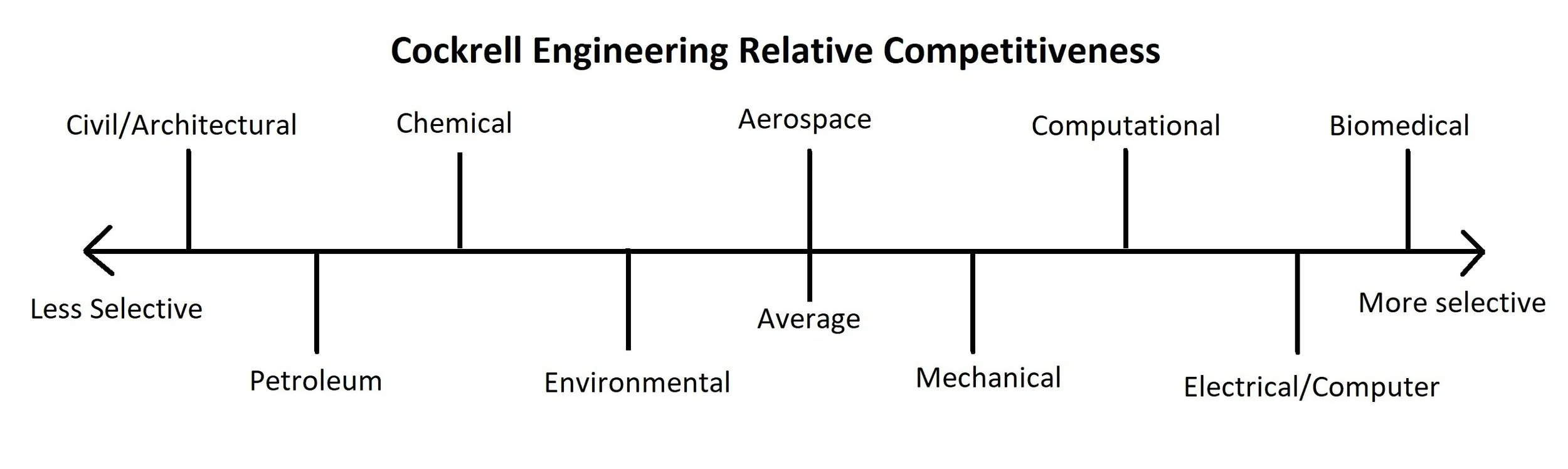
Parden my poor MS Paint skills
Here are also my rules of thumb for assessing whether an applicant is competitive for their desired major, which corresponds with how I perceive the relative competitiveness of each program. Parameters updated for Fall 2023 applicants.

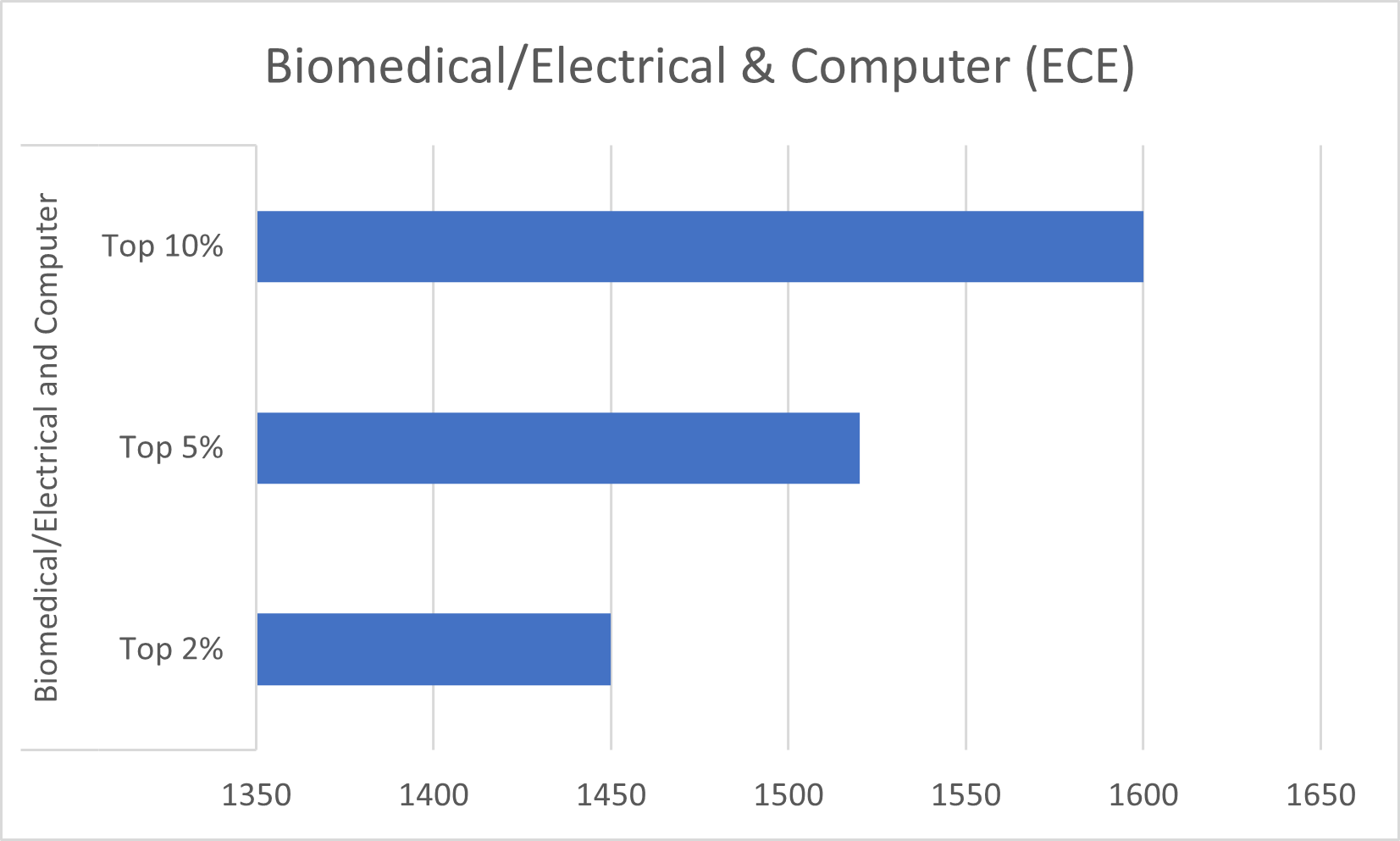


It is critical that you do your research before applying. Reviewers have high expectations that you have a clear idea of why you are applying to your desired engineering discipline and how you hope a UT education will help you after graduation.
Unlike other universities, UT requires students to choose an engineering discipline as HS seniors, with the expectation that they remain in it for all four years. Mechanical Engineering is the most popular and in-demand option because it offers the most career flexibility. They also offer flexible curriculum options through the Career Gateway Electives, which may appeal to students with interdisciplinary interests.
Consider discussing your physics and math classes, as well as an influential teacher. Share an anecdote of a particularly memorable project or independent study. If you’ve taken engineering electives, discuss any relevant themes and how they’ve helped shape your future studies and goals. Write about robotics, engineering competitions, research projects, tutoring, and anything else relevant to STEM.
You should research the different curricula and resources for the many Engineering majors to choose the one that’s your best fit. One way to articulate why you want to study something or pursue a path is to, in your essays, acknowledge a few alternatives and why they interest you less.
In your essays, tell your reviewer “why UT” by identifying a few specific professors, research opportunities, student organizations, etc., that interest you. Pinpointing reasons why you’re applying will help separate your application from others. Saying “UT is the best Engineering program in Texas” or “Austin is a wonderful city” is not enough.
Also consider discussing how you bring a unique perspective to campus and classroom discussions and how you see yourself as a leader on UT’s campus.
For your resume, it is important to expand upon and elaborate as much as possible any relevant Engineering-specific or STEM experience, generally, and how they support your first-choice major. I understand not everyone will have relevant experience, but a record of pursuing your interests can be a difference maker.
Possible Alternatives to Studying Computer Science or Cockrell Engineering
Themes related to automation, robotics, data analysis, electronics, game design, and many other broadly related Computer Science fields often live in different UT departments or have interdisciplinary curricula. If you feel that Computer Science is too competitive, or your interests are more narrowly tailored, you might try related majors like:
McCombs Management Information Systems (MIS)
College of Fine Arts, BS in Arts and Entertainment Technology
College of Natural Sciences, BS in Applied Mathematics or Actuarial Sciences
College of Natural Sciences, BS in Physics or Chemistry on the Computation stream
College of Natural Sciences, BS in Computational Biology
College of Natural Sciences, BS in Space Sciences, Physics
Environmental Science in the College of Natural Sciences, College of Liberal Arts, or the Jackson School of Geosciences
Geological Sciences or Geosystems Engineering, Jackson School of Geosciences
Urban Studies, College of Liberal Arts
Geography, College of Liberal Arts
Majoring in anything else and pursuing an 18-hour Computer Science Certificates on the following topics: Applied Statistical Modeling, The Elements of Computing, Scientific Computations and Data Sciences.
Bridging Disciplines Program Certificates in Design Strategies, Digital Arts and Media, Smart Cities, Innovation/Creativity/Entrepreneurship
Getting into UT-Austin’s College of Natural Sciences (CNS)
CNS has the highest enrollment of any UT college/school, and they also receive the most applications. Years ago, CNS majors were included in the top 6% guarantee, but that's no longer the case. Highly qualified top 6% applicants are routinely rejected from the largest majors like biology and chemistry. Only in the previous few cycles have I received significantly more interest in CNS admissions as communities and schools note the increasingly competitive landscape. I had 9 CNS clients in the Fall 2022 cycle, compared with 2 in 2017, excluding computer science.
In the introduction, I alluded to the fact that we don’t know which CNS majors UT separates out. Computer Science applicants are compared with one another, and I also have reason to believe that neuroscience admissions work in the same way. Environmental science and math may also be considered. So when families ask me which majors among biology, chemistry, or physics are the most competitive, we have no way to know. However, outside of CS and neuroscience, your major choice is unlikely to influence your admissions chances relative to other CNS options.
Given the ambiguities around which CNS majors may be more or less competitive, my best advice is to choose the major you feel you’d be content with spending four or five years studying, taking exams, and conducting undergraduate research. Changing majors within Natural Science once you’ve enrolled used to be straightforward, but not anymore. Most majors require an application and are not guaranteed.
Note that anyone from any major can pursue Pre-Med or other Pre-Health Professions. You DO NOT need to be a biology major to attend medical school. Anyone in any college/school can complete the pre-med prerequisites. Selecting a pre-med interest in Apply Texas does not influence your admissions in any way.
My advice about the need for relevant experience and a substantive STEM transcript for CS and Engineering also applies to CNS. It is essential to have a STEM-oriented application. Some top 2% and 1550 students may be able to get into CNS majors without a STEM resume, but it is increasingly difficult. Even students in the top 10% with a 1450 face an uphill climb and should consider CNS a reach.
You will find the official CNS admissions advice very helpful.
Some relevant experiences and ECs to pursue and possibly include in your essays
Shadowing physicians and clinics
Volunteering at hospitals, science museums, and public health outreach efforts
Hosting or participating in medical fundraisers
Working at the front office in a medical setting
Taking AP biology/chemistry/physics and related electives like medical terminology, medical rotation, health sciences, etc.
HOSA competitions and related school health clubs
Summer programs that explore life, health, and medical sciences
Research opportunities like UT-Austin’s High School Research Summer Academy
Competing in various science fair competitions
Conducting independent research or more formally as part of an AP Research class or other advanced science class
UIL Math and Science or Science Olympiad competitions
Completing Coursera or EdX open courseware curriculum or certificates related to your future major(s)
Honors societies like Mu Alpha Theta or Science National Honors Society
The Freshman Research Initiative (FRI)
FRI is UT-Austin’s flagship undergraduate research program, aiming to ease the transition from high school to campus while connecting students with mentors and research projects immediately. The program offers an Honors-like experience, provides many opportunities, and offers a smaller community than if you didn’t participate. It isn’t the only way to participate in research, but it streamlines the process. Browsing some Reddit posts may help give you an idea of the pros/cons and the student experience.
It started as a UT student pilot project and has since ballooned into a highly desirable opportunity. I include FRI in this post because any incoming CNS freshman who wanted it many years ago could enroll. Nowadays, as with everything else, there are limited spaces and high demand. Most students who apply gain entrance, but it’s not guaranteed. In some years, there has been a lengthy waitlist.
FRI is not something you indicate on your initial application. Consequently, admitted CNS students are invited to apply in the spring of their HS senior year, and they are required to submit additional materials beyond what they submitted on Apply Texas. It is essential to apply as soon as you receive the invitation, as they seem to admit students on a rolling basis. I don’t think FRI has access to your original Apply Texas materials, so you’re probably safe repurposing what you already wrote, perhaps for your Major short answer if applicable.